The first time I saw my grandson eating lunch in a supply closet, I didn’t cry. I got dangerous.
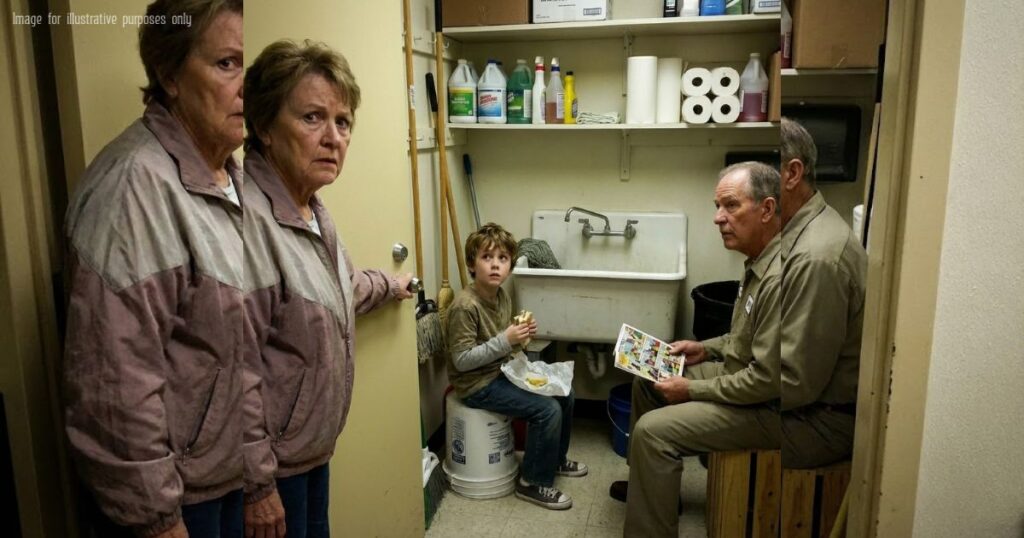
I had come to the school to drop off an inhaler. The cafeteria was a chaotic ocean of noise, but Toby wasn’t there. I found him sitting on a bucket next to the mop sink, unwrapping a smashed peanut butter sandwich. Mr. Henderson, the janitor, was sitting on a crate opposite him, quietly reading a comic book aloud.
“It’s too loud out there, Grandma,” Toby whispered, looking terrified that I would make him go back.
That was 2018. I was 64 years old. I was supposed to be enjoying retirement, gardening, and reading mystery novels. Instead, I was raising a ten-year-old boy on a Social Security check that barely covered the rent of our two-bedroom apartment in a neighborhood that was changing too fast.
Around us, the modest ranchers were being torn down for “Modern Farmhouses.” The driveways filled with electric SUVs. The grocery store stopped selling generic brands and started selling organic kale chips.
And me? I was just “Toby’s Grandma.” The woman in the faded windbreaker driving a 2005 Ford Focus that rattled when it idled.
I joined the PTO (Parent Teacher Organization) the next week. I thought it was about bake sales. I was wrong.
The meetings were held at 10:00 AM on Tuesdays—a time only possible for parents who didn’t punch a time clock. The room smelled of expensive vanilla latte and aggressive perfume. The women wore matching athletic gear that cost more than my monthly grocery budget.
The President was a woman named Diane. She had a smile that didn’t reach her eyes and a planner thick with important dates.
“Okay ladies,” Diane chirped at my first meeting. “We need to approve the budget for the 5th Grade ‘Tech-Integration’ initiative. We’re asking for a mandatory $150 contribution per family to buy personalized tablets and noise-canceling headphones for the honors classes.”
I raised my hand. My arthritis was flaring up, so it didn’t go up very high.
“Excuse me,” I said. My voice sounded rusty. “What about the other classes? The ones that aren’t ‘honors’? Do they get headphones?”
The room went silent. It was that polite, suffocating silence of people who aren’t used to being questioned.
“Well, Linda,” Diane sighed, like she was explaining quantum physics to a toddler. “The General Education classrooms have the shared computer cart. It’s perfectly adequate. Besides, most of those families haven’t… contributed to the Fall Gala fund.”
“The computer cart has six working laptops for thirty kids,” I said. “And the ‘contribution’ is voluntary. Public education is supposed to be free, isn’t it?”
Diane took a sip of her coffee. “We want our children to be competitive, Linda. If you’re having trouble with the fee, there’s a form you can download, print, notarize, and submit for review by the board.”
A form.
To them, it was just paperwork. To people like me—and the single dad working two shifts at the Amazon warehouse, and the waitress mom pulling doubles at the diner—it was shame. It was a digital barrier designed to keep us quiet.
That’s when the whispers started.
“She’s difficult.” “She’s abrasive.” “She doesn’t understand how the real world works.”
They stopped sending me the email reminders for meetings. But I showed up anyway. I sat in the back, wearing my discount sneakers, writing everything down in a spiral notebook.
I wasn’t doing it for fun. I was doing it for Toby. And for the little girl, Maya, whose sneakers were held together with duct tape. And for Jason, who fell asleep in class because he was watching his baby sister all night while his mom worked.
The breaking point came in May. The “End of Year Extravaganza.”
It was a field trip to a massive trampoline park and arcade complex. The cost was $45 per student.
“What happens to the children who can’t pay?” I asked during the April meeting.
Diane didn’t even look up from her phone. “Oh, we have a plan for them. They’ll stay behind in the library. Mr. Henderson will put on a movie. We’ll give them popcorn so they don’t feel left out.”
Left out.
Imagine being ten years old. Watching three buses load up with your laughing friends, waving their neon wristbands, while you are marched back into the building to watch a DVD you’ve seen a dozen times, just because your grandmother lives on a fixed income.
I stood up. My knees popped, loud in the quiet room.
“No,” I said.
“Excuse me?” Diane blinked.
“No,” I repeated, louder this time. “You are not leaving those children behind. If the PTO has $10,000 in the bank for ‘Teacher Appreciation Yoga Mats,’ you can subsidize the trip for the twelve kids who can’t afford it.”
“It’s not in the budget, Linda. And frankly, it’s not fair to the parents who paid full price.”
“Fair?” I laughed, but there was no humor in it. “You want to talk about fair? Fair is making sure every child feels like they belong in this school. You are punishing children for their parents’ bank accounts.”
“If you don’t like it, you can leave,” Diane said, her voice icy.
So I did.
I walked out of that school and went straight to the bank. I withdrew $300 from my emergency fund. That was my money for car repairs. It was my “what if the furnace breaks” money.
Then I went to the Dollar Store. I bought water balloons. I bought sidewalk chalk. I bought cheap canvas and paints. I went to the grocery store and bought 40 hot dogs and a generic bag of charcoal.
I made a flyer on my ancient home printer.
“THE COOL KIDS BACKYARD BASH. Free. Everyone Invited. No Money Needed.”
On the day of the fancy field trip, twelve kids didn’t get on the bus. They came to my tiny, patchy backyard.
We didn’t have a trampoline park. We had a sprinkler hooked up to a hose. We didn’t have arcade games. We had a water balloon fight that lasted an hour. We grilled hot dogs until they were charred and perfect. Mr. Henderson, the janitor, showed up on his lunch break with a guitar and taught the kids how to play three chords.
Toby smiled that day. A real smile. Not the nervous, apologetic smile he wore at school. He laughed until soda came out of his nose.
For six hours, those kids weren’t “low income.” They weren’t “at risk.” They were just kids.
That night, as we were cleaning up paper plates, Toby looked at me. “Grandma? That was better than the trampoline place.”
“How do you know?” I asked. “You’ve never been.”
“Because nobody looked at us like we didn’t belong here,” he said.
That broke my heart and healed it all at once.
Toby is 22 now. He just graduated from college—the first in our family. He’s working as a guidance counselor at a middle school in the city. He keeps a jar of granola bars in his desk for the hungry kids, and he eats lunch in the cafeteria every single day, sitting with the kids who are alone.
He told me once, “Grandma, you taught me that you don’t need a seat at the big table to make a feast. You just need to build your own table.”
Last week, I ran into Diane at the pharmacy.
Time is the great equalizer. The expensive highlights were gone, replaced by gray. She looked tired. She was buying generic blood pressure medication—the same brand I buy.
I almost walked past her. But she stopped me.
“Linda?” she asked.
I nodded.
She looked down at her shopping cart. “I saw… I saw Toby’s name in the paper. Dean’s List. That’s wonderful.”
“He’s a good man,” I said.
Diane hesitated. She looked smaller than I remembered. “You know, back then… I thought I was protecting the school’s standards. I thought you were just… noise.” She looked up at me, and her eyes were wet. “My daughter… she doesn’t talk to me much anymore. She says I cared more about how things looked than how people felt. I think about those meetings sometimes. I think you were the only one who was actually seeing the children.”
She didn’t ask for forgiveness. I didn’t offer it. But as I walked to my rattling Ford Focus, I felt lighter.
We live in a world that loves to label people. If you speak up, you’re “aggressive.” If you’re poor, you’re “lazy.” If you challenge the system, you’re “trouble.”
But let me tell you something, from one tired grandmother to another: Be trouble.
Be the “difficult” one. Be the one who asks the uncomfortable question when everyone else is sipping their coffee in silence.
Because right now, somewhere in a school hallway, or a lunchroom, or a playground, there is a child sitting on a bucket in a janitor’s closet because the world is too loud and too expensive for them.
They are waiting for someone to open the door.
Don’t wait for permission. Don’t wait for the budget to be approved. Don’t wait until you have the “right” clothes or the “right” car.
Open the door.
Even if your hand is shaking. Especially then.
—
If the story ended with a backyard full of water balloons and a rattling old car, this would be a neat little memory you share at Thanksgiving.
But stories don’t end when the bell rings, and they definitely don’t end when the kids grow up. They follow you into every cafeteria you ever walk into.
I learned that the day Toby called me from his office.
“Grandma, do you have a minute?” he asked. His voice had that tight edge I knew too well. It was the same voice he used before a panic attack when he was ten.
Click the button below to read the next part of the story.⏬⏬