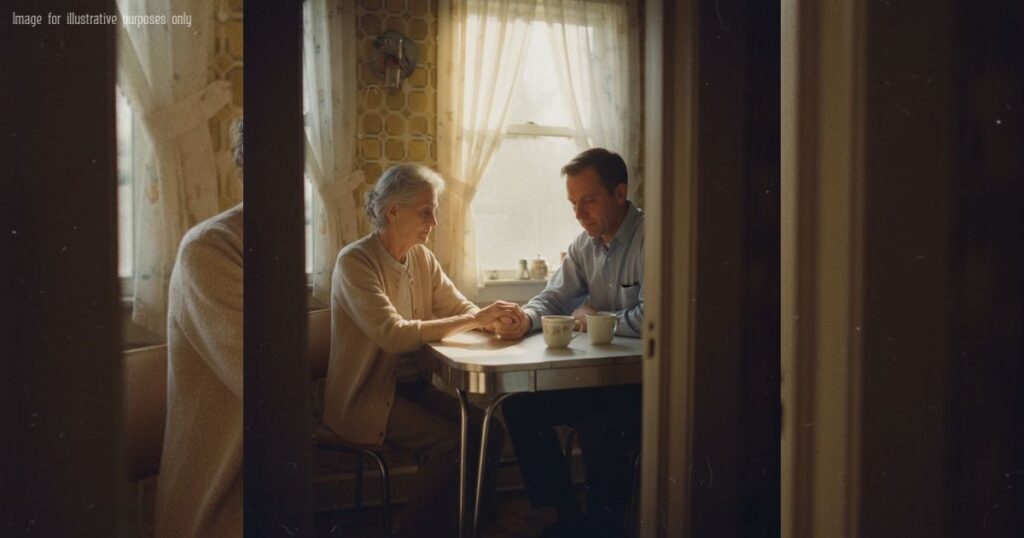
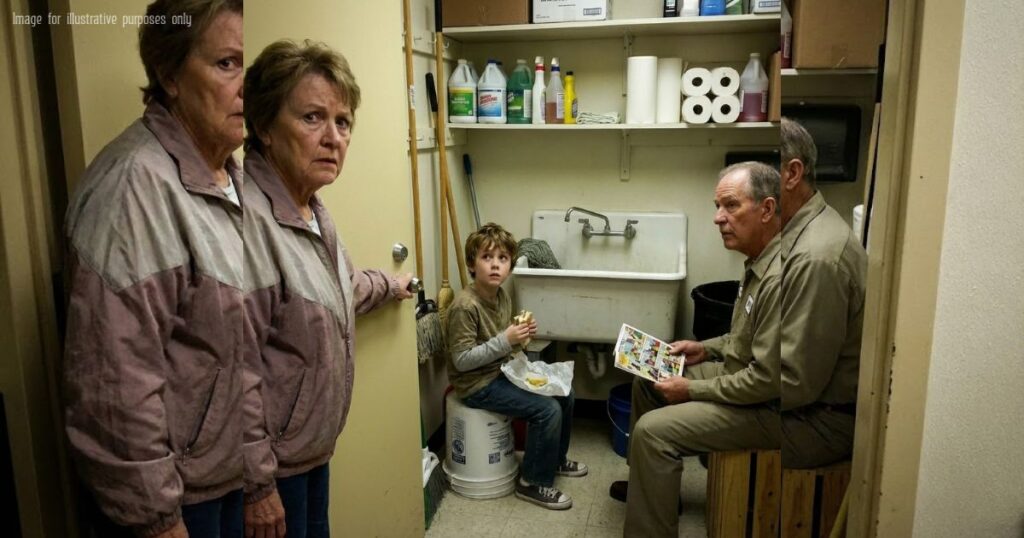
If the story ended with a backyard full of water balloons and a rattling old car, this would be a neat little memory you share at Thanksgiving.
But stories don’t end when the bell rings, and they definitely don’t end when the kids grow up. They follow you into every cafeteria you ever walk into.
I learned that the day Toby called me from his office.
“Grandma, do you have a minute?” he asked. His voice had that tight edge I knew too well. It was the same voice he used before a panic attack when he was ten.
“Always,” I said. I was sitting at my kitchen table with my coupon folder open, half-clipped ads forgotten. “What’s going on?”
He exhaled into the phone. I could hear the muted roar of a middle school hallway behind him. Lockers slamming. Someone laughing too loud. The static of adolescence.
“I just found a sixth-grader eating in the stairwell,” he said. “He told me it’s his ‘quiet lunch spot.’ The cafeteria’s too much for him. The noise, the pushing, the ‘where’d you get that shirt’ comments. He said a teacher told him, ‘If you don’t like it, find somewhere else.’”
My hand gripped the phone a little tighter. “Was he alone?”
“Yeah,” Toby said. “Sitting on the floor with a lunch that was mostly sugar. And when I asked if his parents knew, he said, ‘They’re busy. They work.’” He paused. “Grandma, it was like looking at a shorter version of me. Except this kid doesn’t have a janitor who’ll sneak him comic books in a closet.”
Something hot and familiar rose in my chest.
“What did you do?” I asked.
“I brought him into my office. Gave him a granola bar. Sat with him while he ate,” Toby said. “But I keep thinking… I’m just one person in one office with one jar of snacks. The system is still the system.”
The word hung there between us: system. People say it like it’s a storm or an earthquake—something untouchable and inevitable.
“Do your colleagues know kids are eating in stairwells?” I asked.
“Some do,” he said. “Some think it’s ‘self-regulation.’ Some are just trying to survive their own day. We had a staff meeting about ‘optimizing the lunch flow’ last week. They talked about line speed and supervision ratios. Not one word about the kids who disappear.”
I was quiet for a moment. I could almost see him, spinning in his wheeled chair, running a hand through his hair the way his grandfather used to when bills piled up.
“Toby,” I finally said. “You remember the field trip? The trampoline place?”
He laughed softly. “Grandma, the whole internet remembers that story. You’ve told it to anyone who stands still long enough.”
“Well, now I’m going to tell it to people who aren’t standing still,” I replied before I could overthink it. “Send me a picture of that stairwell.”
“Grandma, I can’t send you a picture of a student,” he said gently. “Privacy laws. Ethics. All that.”
“I don’t need a picture of the boy,” I said. “I need a picture of the place. Just the empty stairwell. The spot where a kid was eating alone because the world was too loud.”
He went quiet, thinking. “I can do that,” he said finally. “No faces. No names. Just an empty corner.”
Ten minutes later, my phone buzzed. There it was: gray walls, chipped paint, a metal handrail, a triangle of floor where the light didn’t quite reach. A place that technically “met guidelines” but felt like exile.
I stared at that picture for a long time.
Then I did something my grandchildren had been begging me to do for years: I joined social media.
I made an account on a platform I won’t name, but you know the one. The one where people post vacation photos and arguments about everything. I chose a profile picture where my hair behaved for once, and I typed, “Just a grandma trying to keep kids out of closets.”
Then I told the story.
I wrote about the supply closet in 2018. I wrote about the PTO meetings and the “mandatory” donations and the field trip and the backyard bash. I wrote about Toby’s jar of granola bars and the boy in the stairwell.
I ended the post with a question:
“Be honest with me, parents and grandparents and teachers: Is a child eating alone in a stairwell ‘self-regulation’? Or is it a quiet way of saying, ‘We don’t have room for you at the table’?”
I hit “post” with my heart pounding like I’d just crashed a school board meeting again.
I expected maybe twelve likes and a couple of “You go, Grandma!” from my bingo group. Instead, my phone lit up like a slot machine.
Within an hour, my little story had been shared over a hundred times.
Within a day, it was thousands.
People I’d never met were commenting. Some of them were kind:
“My son eats lunch in the bathroom every day. Thank you for talking about this.”
“I work in a school cafeteria. We’re drowning. We want to help these kids, but we’re short-staffed and overrun. We need backup.”
“My grandma did something like this for me. I’m a teacher now because of her.”
Others were… not so kind.
“Maybe if parents taught their kids resilience instead of coddling them, they could handle a cafeteria like everyone else.”
“So now we’re supposed to feel bad for kids whose families don’t prioritize school fees? Life has consequences.”
“You’re teaching kids that they never have to adapt. The world won’t give them a quiet stairwell at their jobs.”
“Must be nice to sit on the internet blaming the ‘system’ instead of raising better kids.”
I sat there at my kitchen table reading it all, my tea growing cold.
“Toby,” I texted, “there are people on here who would’ve shoved you back into that cafeteria and locked the closet behind you.”
He texted back one word: “I know.”
The post kept spreading.
A local parent blog reached out asking if they could share it. A youth counselor group asked if they could use it in a training about inclusion. A journalist from a small online outlet wanted to interview me about “alternative care work in public schools.”
And then the school district notice came.
Not from Toby’s district, to be clear. From mine.
An email landed in my inbox with a subject line that practically screamed: “COMMUNITY EXPECTATIONS REGARDING ONLINE POSTS.”
It wasn’t addressed to me by name. It was sent to every parent and guardian in the district. But I could read between the lines. They might not say “Linda,” but the shoe fit.
The letter talked about “mischaracterizations of school policy” and “the importance of addressing concerns through appropriate channels” instead of “viral anecdotes.” It reassured everyone that “no student in our district is ever denied a safe and welcoming lunch environment due to financial hardship.” It ended with a paragraph about “community unity.”
I snorted into my tea.
I remembered that library “movie day” they’d planned for kids who couldn’t afford the field trip. I remembered the form that required proof of income. I remembered the way certain adults relaxed when poor kids disappeared for a day.
I clicked “reply.”
I did not shout. I did not name names. I wrote:
“Thank you for your email. I am glad to hear that our district believes every child deserves a safe and welcoming lunch environment. To help us all live up to that, could you please clarify:
- How many students in the past five years have been kept back from field trips due to unpaid fees?
- How many students regularly eat lunch outside of the cafeteria, and why?
- What is the process for a child without a quiet sensory space to request one, without their family having to share medical or financial details publicly?”
I hit send.
I didn’t expect a response.
I got one within twenty-four hours.
It was polite. It was careful. It did not contain any numbers.
It talked about “ongoing data collection” and “confidentiality” and “appreciation for community engagement.” It invited me to join a “Family Advisory Committee” that met once a month on a weekday morning. No stipend. No childcare. No transportation support.
In other words: the same table, new name.
I almost deleted the email.
Instead, I posted again.
This time I wrote:
Click the button below to read the next part of the story.⏬⏬