“They invited me to another table that poor people can’t easily reach. I’m not saying no. I’m asking for a new table.”
Underneath, I typed:
“When we build solutions that only people with flexible jobs, reliable cars, and free mornings can attend, we’re not building solutions. We’re building mirrors.”
The comments exploded again.
“YES. THIS.”
“Say it louder.”
“My mom worked double shifts. She never would’ve made those meetings. People like her still don’t have a voice.”
“Well maybe if people worked harder they could get better jobs and attend,” someone wrote, right on cue.
There it was. The sentence that shows up in every conversation about inequality like a bad penny: work harder.
I sat with that for a long time.
Then I typed, slowly:
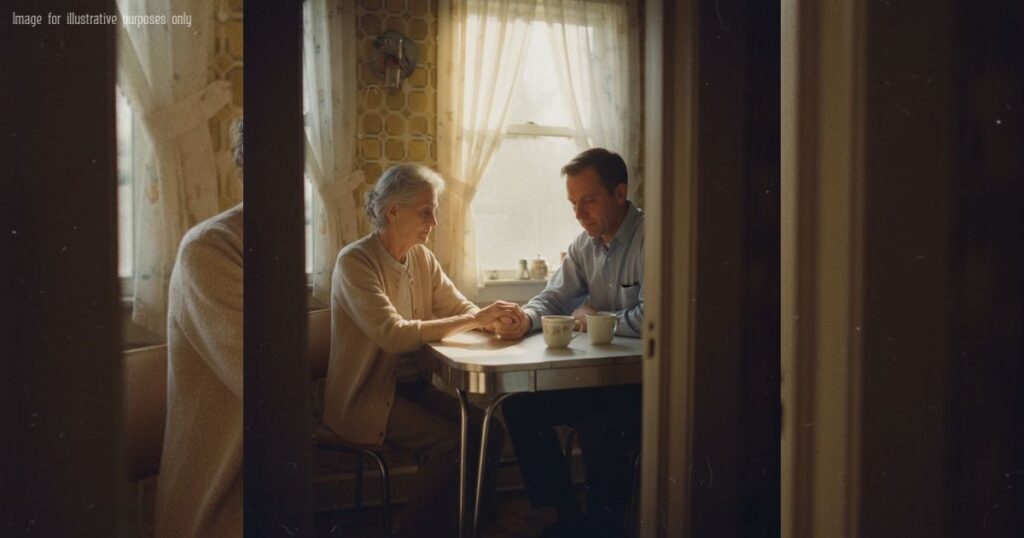
“My daughter worked nights at a nursing home, days cleaning houses, and weekends doing odd jobs until her body gave out. She didn’t miss meetings because she didn’t care. She missed them because she was exhausted. She died at fifty-one with a spine like a ninety-year-old. Please tell me again about working harder.”
I hovered over the “post” button, knowing full well that this would be the paragraph that people would fight over in the comments.
I posted it anyway.
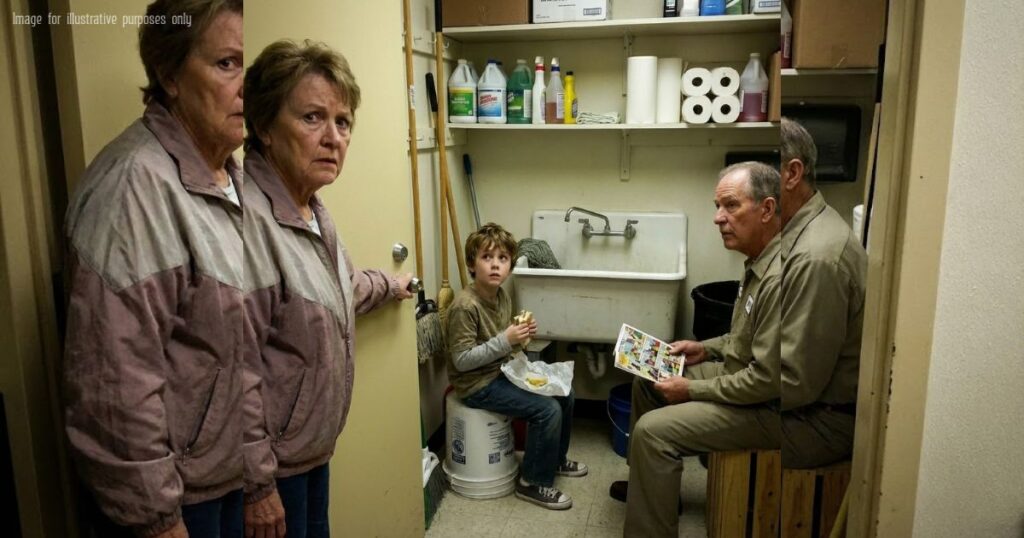
Because here’s the thing no one tells you: once you’ve watched a kid eat lunch on a bucket next to a mop sink, you stop being scared of internet strangers.
You’re already haunted by something real.
A week later, Toby called me again.
“Grandma,” he said, “you broke our staff group chat.”
“Did I?” I asked, turning down the volume on the game show I wasn’t really watching.
“Apparently,” he said. “Half the staff are sharing your posts like a manifesto. The other half are worried about ‘community backlash.’ Our principal called a meeting. A big one. Students, parents, staff. They want to talk about lunch.”
“About lunch,” I repeated. “After all these years.”
“Will you come?” he asked.
My first instinct was to say no. I was tired. I was older. I was very aware that it’s easier to be brave behind a keyboard than under fluorescent lights in a multipurpose room.
But then I thought about that stairwell.
“I’ll be there,” I said.
The night of the meeting, the parking lot was full. I recognized the minivans with the pristine paint and the cars with mismatched doors. People in business suits, people in fast-food uniforms, people in leggings and oversized sweatshirts. The whole spectrum.
They handed everyone sticky name tags at the door. Mine said “Linda — Grandmother.”
Inside, the chairs were arranged in a circle instead of rows. That was new.
The principal, a tired-looking man about my age, cleared his throat. “Thank you all for coming,” he said. “We’re here to talk about lunch. And about belonging.”
They let students speak first.
A girl with chipped black nail polish talked about the noise and the pushing and the way nobody notices when you sit alone if you’re quiet enough.
A boy with a neatly ironed shirt talked about saving up for field trips by doing chores for neighbors and how ashamed he felt when even that wasn’t enough.
A kid with headphones around his neck, not on his ears, said, “I love my friends, but sometimes the cafeteria feels like standing in front of a speaker at a concert. My brain can’t hear anything but static.”
Then parents talked.
Some shared stories like mine.
Some worried that creating special spaces would “coddle” kids or “reward bad behavior.”
One mother stood up and said, “My son works hard for his privileges. It’s not fair to just give everyone the same experience.”
A father in a worn work jacket replied, “My kid works hard too. He just starts from farther back.”
You could feel the room shift on that sentence.
Then they called on me.
I stood up slowly. My knees sang their usual protest.
“I’m Linda,” I said. “I’m the grandma with the backyard hot dogs.”
There were a few chuckles. A few nods. A teenager in the back raised a hand in a little fist pump like I was a rock star, which I assure you I am not.
“I’ve been called a lot of things in the last few weeks,” I continued. “Some kind. Some not. But most of those words orbit around one idea: fairness.”
I looked at the mother who’d talked about privileges, then at the father with the work jacket, then at the kids who’d spoken.
“When Toby was ten,” I said, “someone decided it was fair that he eat in a supply closet because the cafeteria made him feel like he was drowning. When some kids couldn’t afford the field trip, someone decided it was fair that they watch a movie in the library so the others could bounce on trampolines guilt-free. When a boy at this very school ate in a stairwell last week, someone decided it was fair to let him ‘self-regulate’ alone.”
I let that sit for a moment.
“Here’s what I’ve learned in sixty-nine years: if your version of fair always, always requires the quiet kids, the broke kids, the overwhelmed kids, the disabled kids to shrink themselves so you don’t have to change anything… it’s not fairness. It’s comfort.”
A murmur moved through the room.
I took a breath.
“Is it controversial to say that?” I asked. “Maybe. So be it. But we’re not talking about buying everyone a sports car. We’re talking about a place to sit and something to eat and a room that doesn’t feel like a hurricane.”
I turned to the principal.
“So I’m not here to demand a brand-new building or designer furniture. I’m here to ask for three very simple things:
One: No child in this school misses a field trip because of money. If that means fewer decorations or cheaper venues, so be it.
Two: No child is allowed to eat lunch alone in a stairwell or a bathroom. Not because they’re in trouble. Not because the adults are too busy. Not because we’ve decided solitude is ‘good for them’ without asking.
Three: Every student who needs a quieter space has access to one that isn’t a storage closet. A real room. Real chairs. Real supervision. Not a favor. A right.”
Someone in the back said, “Who’s going to pay for all this?”
I smiled. There it was—the other reliable guest at every meeting.
“Some of it will cost money,” I said. “Some of it will cost convenience. All of it will cost the illusion that we’ve already done enough.”
I could feel eyes on me. Some soft, some sharp.
“Let me be very clear,” I added. “I’m not saying you’re bad parents if you’ve ever paid for an extra program for your child. I’m not saying you’re a bad teacher if you’ve ever been too tired to notice who was missing from the lunch table. I’m saying we are all in danger of getting so used to the way things are that we stop seeing the kids in the stairwells.”
I sat down to applause. Not unanimous. But loud.
The meeting went on for another hour. There were disagreements. There were eye-rolls. There were breakthroughs.
They formed a committee—not the old weekday-morning kind, but one that met in the evening and offered childcare and translation headsets and a virtual option for people on night shifts. They asked students to join. They asked cafeteria staff and bus drivers and the reading specialist who buys her own stickers.
They turned an old conference room into what the kids named “The Peace Corner”—a space where students who need a calmer lunch can eat with a staff member or volunteer. Not hidden. Not a punishment. Just another way to belong.
They rewrote the field trip policy. If a family can’t pay, the school quietly covers the cost from a general fund built from voluntary donations, not shame.
Is it perfect? Of course not.
There are still days when kids slip through cracks. There are still parents who complain in anonymous group chats that “we’re lowering standards” or “rewarding laziness.” There are still staff who think we’re making a big deal out of nothing.
And there are nights when I lie awake wondering if I’ve started something I can’t finish.
But then Toby sends me a picture.
Not of a stairwell this time.
Of a crowded table in the new Peace Corner—three kids playing cards, one drawing, one just leaning back with their shoulders finally unclenched. Toby is in the corner of the frame, half in, half out, holding a sandwich in one hand and a stack of hall passes in the other, laughing with his whole face.
Underneath the photo, he writes:
“Look, Grandma. We built another table.”
This, right here, is the part where you decide what kind of character you want to be in your own story.
Maybe you’re reading this and you’re furious with me. Maybe you think I’m coddling kids. Maybe you believe deeply in teaching “toughness,” in consequences, in learning to sink or swim.
Okay.
Ask yourself this: when was the last time you checked who was allowed in the pool in the first place?
Maybe you’re cheering. Maybe you’re remembering a teacher, a coach, a neighbor who made space for you when no one else did.
Good.
Tell their story out loud. Say their name at the dinner table. Tell your kids why you made it through.
Or maybe you’re somewhere in the middle. Tired. Overwhelmed. Staring at your bank account, your schedule, your own childhood ghosts, and thinking, “I can’t fix all this. I can barely keep my own head above water.”
Me too.
Here’s the secret no one puts in the inspirational posters:
You don’t have to fix the system to change a child’s life. You just have to notice the ones hiding in stairwells and supply closets and back tables—and then be willing to be a little bit of trouble on their behalf.
So argue with me in the comments if you want. Tell me I’m wrong. Tell me kids need to be tougher. Tell me we can’t afford this, or that it’s not our job.
And then, tomorrow, when you walk into a school—or past one, or by a bus stop, or through a grocery store after 3 PM—look for the child who’s standing alone with a lunch that looks more like an afterthought than a meal.
Look for the kid who flinches at sudden noise, who hovers on the edge of the group, who pretends they don’t care.
You don’t need a committee or a budget or an official title to do what comes next.
You just need to open a door.
Thank you so much for reading this story!
I’d really love to hear your comments and thoughts about this story — your feedback is truly valuable and helps us a lot.
Please leave a comment and share this Facebook post to support the author. Every reaction and review makes a big difference!
This story is a work of fiction created for entertainment and inspirational purposes. While it may draw on real-world themes, all characters, names, and events are imagined. Any resemblance to actual people or situations is purely coincidenta