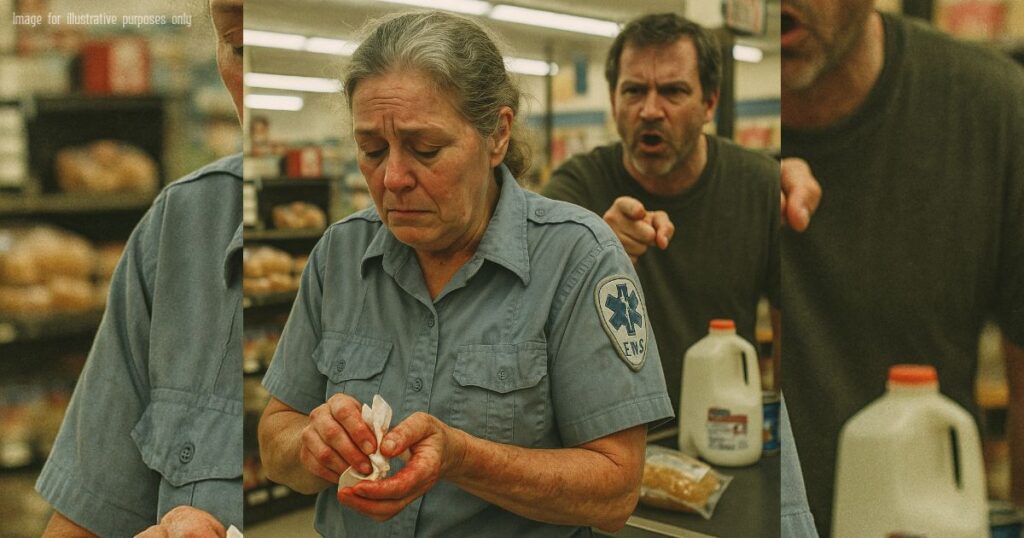
“I was scrubbing a stranger’s blood out of my fingernails when a man in line at the grocery store told me I was a ‘leech on the American taxpayer.’”
I didn’t say a word. I just paid for my milk and bread, walked to my truck, and sat there in the parking lot until my hands stopped shaking.
I never thought I’d end a 38-year career feeling like a ghost in my own country.
In twelve days, I turn in my badge. There won’t be a parade. There won’t be a city-wide celebration. Just a cardboard box, a locker with a rusted hinge, and a uniform that hangs a little looser on me than it used to. I’m walking out the back door the same way I walked in—quietly.
But this job… it carved itself into my bones. And before I hang it up for good, I need to say something. Not because I want pity—I’m too old for that—but because the truth matters. And right now, it feels like nobody is listening.
I started this work back when Reagan was in the White House. I was twenty years old, bulletproof, and thought I was going to save the world. My first call was a pile-up on the interstate. No GPS, no cell phones, just a map book and a gut feeling. I remember the smell of gasoline mixed with the sweet, sick scent of antifreeze. We lost a father that night. I remember the way the red lights of the rig pulsed against the broken glass on the asphalt. It looked like a kaleidoscope.
That night broke me. And then it rebuilt me.
Since then, I’ve worked through blizzards that shut down the entire state, heatwaves that melted the tarmac, and floods that swallowed entire neighborhoods. I have pulled teenagers out of crushed sedans and grandmothers out of burning colonials. I have seen life begin in the back of a rattling ambulance doing eighty miles an hour, and I have held the hands of veterans as they took their last breath because they had no family left to sit with them.
Some ghosts you carry forever.
I still dream about a boy from the flooding of ’93. The water was rising fast—dirty, brown, freezing river water. We found him clinging to a gutter on a second-story roof. He was wearing Spider-Man pajamas, shivering so hard his teeth clicked. When I grabbed him, he locked his arms around my neck like a vice. He whispered, “Please don’t drop me.”
I didn’t. I carried him through chest-deep water, feeling the debris hit my legs, praying I wouldn’t step in a hole. I think about that kid every single time it rains hard in April. I wonder if he has kids of his own now. I wonder if he knows that for twenty minutes, he was the only thing in the world that mattered to me.
But the world has changed.
Back then, wearing this patch meant something. People waved. Kids ran up to the ambulance at stoplights just to say hi. We weren’t rich—Lord knows you don’t do this for the money—but we were part of the community. We were respected.
Now? Now we are understaffed, underfunded, and overwhelmed.
I walk into a coffee shop in uniform now, and I feel the eyes on me. Sometimes it’s indifference. Sometimes it’s open hostility. Last week, that guy called me a “leech” because of my pension—a pension I paid into with broken bones, missed Christmases, and a back that will never stop hurting.
We have rookies quitting after two years because they can make more money managing a fast-food drive-thru than they can saving lives. Think about that. The person shocking your heart back into rhythm is worrying if they can afford gas to get home.
We have paramedics working three jobs just to pay rent. We have departments where the equipment is held together with duct tape and prayers. And mental health? In my day, you just “sucked it up.” We drank. We stayed quiet. We buried it. Now, we know better, but the help still isn’t there. We just carry the trauma until the bucket overflows.
I’ve had two shoulder reconstructions. My left knee is bone-on-bone. I have hearing loss from the sirens. But you know what hurts worse than the arthritis?
Watching this country forget us.
No politician wants to take a photo with a burnt-out, 60-year-old medic. They want the shiny new fire truck. They want the soundbite. But when the cameras turn off, we’re the ones left sweeping up the glass. We’re the ones holding the mother who just lost her son to an overdose. We’re the ones telling an elderly man that his wife of fifty years is gone.
I’ve knocked on doors during tornado warnings when the sky was turning green, begging people to take cover. I’ve been hugged by total strangers in the middle of a highway because I was the only person who showed up.
And I’ve done it all knowing we were one bad step away from not coming home.
There was a night a few years back—a massive storm system tore through the county. Flash flooding. I was on the swift-water team. We lost radio contact with dispatch for 45 minutes. Pitch black. Rain coming down sideways. I was standing on the roof of a submerged pickup truck, screaming into the wind, hoping my partner could hear me.
For 45 minutes, I thought about my wife. I thought about how I hadn’t fixed the porch light yet. I thought about how I never told my daughter I was proud of her new job.
We made it out. We saved a man that night who was clinging to a fence post. But I never told my wife how close it was. I didn’t want her to carry that fear.
But now that I’m at the end, the weight is heavy.
We don’t talk enough about the silence that comes after the career. You spend a lifetime living on adrenaline—car wrecks, heart attacks, house fires—and then, Tuesday comes, and the pager is silent. You hand over your radio. You clean out the locker. You go from being “Essential” to being “Retired.”
I look around at this country now—the anger, the division, the shouting—and I wonder if it was worth it. Not the lives saved—I’d do that again in a heartbeat. But the sacrifice.
I know I’m not alone.
I have friends—good men, strong women—who are driving for Uber and DoorDash right now because their retirement benefits don’t cover the cost of their insulin. I know a guy who had to sell his family home because his disability pay got cut. These are people who ran toward the explosions.
We didn’t ask for statues. We didn’t ask for fame. We just wanted dignity. We wanted to know that when we couldn’t carry the stretcher anymore, the system wouldn’t leave us behind.
But we still have each other.
There is a bond in this line of work that civilian life can’t touch. We’ve seen the absolute worst of humanity, and we’ve seen the holy, beautiful best. We’ve shared stale coffee at 3 A.M., covered in soot and sweat. We’ve sat in silence after the calls that didn’t go right.
If you’ve never stood shoulder-to-shoulder with someone while the world is literally burning around you, you don’t know what brotherhood is.
So, as I pack up this locker for the last time, I want to say this:
To my brothers and sisters still on the rig: I see you. I know you’re tired. I know your back hurts and you’re missing your kid’s soccer game. But you matter. Even if the news cycle has moved on. Even if the public is angry. You are the light in someone’s worst nightmare. Keep showing up.
To the people reading this who have never worn the uniform: Next time you see an ambulance or a fire truck, maybe just give a wave. If you see a medic in line at the gas station, maybe just say “thanks.” Remember that inside that uniform is a human being. We bleed, we cry, and we worry about our bills just like you.
And to the young ones thinking about signing up: Come in with your eyes open. Know that you won’t get rich. Know that you will see things that will change you forever. But also know this: You will save lives. You will be the reason a father gets to walk his daughter down the aisle. You will be the reason a child gets to grow up.
You won’t always get the applause. But you will earn something that money can’t buy: Purpose.
And at the end of the day, when the lights go out and the noise stops… that’s all I ever wanted.
Stay safe out there.
—
If you read my first letter and thought, “Well, that’s sad, but that’s just how life is,” this part is for you.
Because after I hit “post,” something happened I didn’t expect.
The story of an old medic quietly retiring should have sunk like a stone. Instead, it spread.
A co-worker’s kid showed it to me on their phone the next day. Thousands of shares. Tens of thousands of comments.
Click the button below to read the next part of the story.⏬⏬