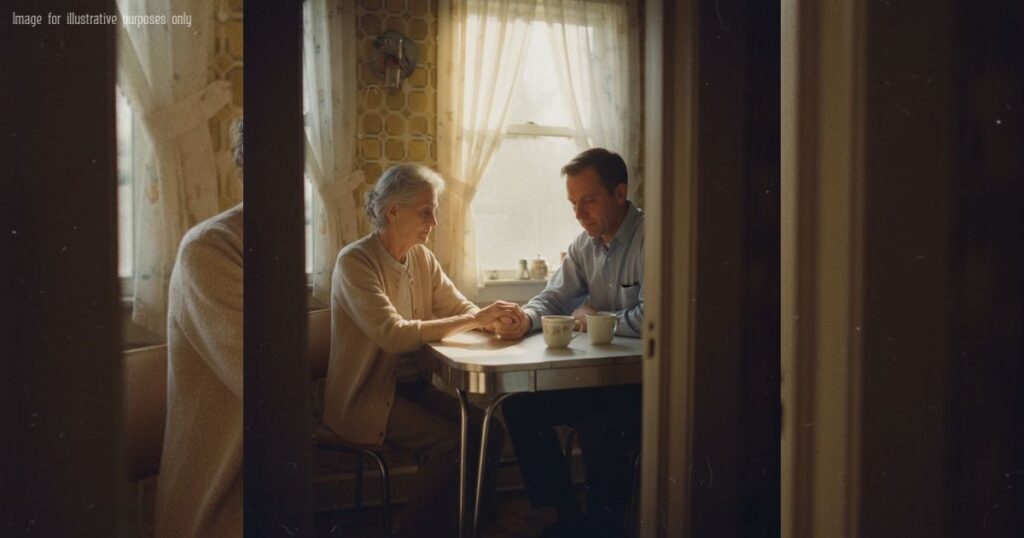

I looked at the man sleeping in the recliner across the room today and realized something that terrified me: I didn’t recognize him.
If you walked into my house right now, you’d see him. His hair, once thick and dark as a raven’s wing, is now thin and shocking white. His skin, once tight across high cheekbones, is mapped with deep valleys and lines. He was wearing an old, faded t-shirt from a hardware store, his mouth slightly open, a soft whistle of a snore escaping with every breath.
I looked down at the photo frame in my lap. It was us, June 1985.
The boy in the picture was wearing a slim black tuxedo, looking at the camera with a cocky, “I can conquer the world” grin. I was next to him, drowning in lace and hairspray, eyes bright with a naive hope that makes my chest ache today. We looked like movie stars. We looked invincible.
I looked back at the old man in the chair. The soft belly rising and falling. The reading glasses sliding down his nose. The way his hand twitched in his sleep, the knuckles swollen from arthritis.
He is a stranger to that boy in the photo. And thank God for that.
We live in a world that tells us love is supposed to be a constant adrenaline rush. Movies and social media tell us that if the “spark” fades, if the butterflies stop fluttering, something is wrong. They tell us to chase the dopamine, to find ourselves, to upgrade.
But let me tell you the truth about the man in the chair.
That boy in the photo? He was fun. He drove a beat-up Ford with the windows down, singing Springsteen at the top of his lungs while I laughed in the passenger seat. He bought me flowers on payday.
But that boy didn’t know anything about survival.
That boy hadn’t sat at the kitchen table at 2:00 AM in 2008, head in his hands, surrounded by bills we couldn’t pay after the factory cut his shifts. He hadn’t felt the crushing weight of shame as we debated whether to pay the electric bill or buy groceries for the week.
That boy hadn’t held me on the bathroom floor, rocking me back and forth while I wailed into his shirt, mourning the baby we never got to meet. That boy didn’t know how to sit in the silence of a car ride home from a funeral, when there are no words left in the English language to fix the pain.
The boy in the photo was a romantic. But the man in the chair? He is a soldier.
I remember a winter night about ten years ago. My mother had just been moved into hospice care. I was falling apart, snapping at him, angry at the world, angry at God. I told him to leave me alone. I told him he didn’t understand.
Most men would have walked away to let me cool off. Most men would have slept on the couch to avoid the drama.
He didn’t.
He walked into the kitchen, made me a cup of tea, and just stood there. He didn’t try to fix it. He didn’t offer clichés. He just leaned against the counter and said, “I’m not going anywhere, Sarah. You can scream, you can cry, you can push. But I’m staying right here.”
That wasn’t the boy from 1985. That was the man who had been forged in the fire of thirty years of “for better or for worse.”
We have scars. Lord, do we have scars.
There were years where we were more like roommates than lovers. There were months where the only things we said to each other were logistical: “Did you pick up the dry cleaning?” “The dog needs to go out.” There were nights I lay in bed, staring at the ceiling, wondering if we had made a mistake. Wondering if there was someone out there who would understand me better.
But every time I drifted, he was the anchor.
It wasn’t always grand gestures. It wasn’t trips to Paris or diamond necklaces. It was the sound of him scraping the ice off my windshield at 5:00 AM in freezing temperatures so I wouldn’t be cold going to work. It was him taking a second job on the weekends to pay for our daughter’s braces, coming home exhausted with grease under his fingernails, yet still smiling when she showed him her report card. It was the way he learned to cook—badly, at first—when I broke my leg, just so I wouldn’t have to stand.
I looked at the photo again. That young couple didn’t know that “I do” isn’t a sentence you say once.
“I do” is a choice you make every single morning.
It’s choosing to forgive the harsh word spoken in hunger. It’s choosing to share the remote control. It’s choosing to hold a hand that has become spotted and rough, not because it’s exciting, but because it feels like home.
Society tells us to fear aging. We dye our hair, we cream our wrinkles, we hide the evidence of time. But looking at him now, I see the beauty in the decay.
Every gray hair on his head is a receipt for a bill he helped pay. Every line on his forehead is a worry he carried so I didn’t have to carry it alone. That softness around his middle? That’s from years of Sunday dinners, of birthday cakes, of pizza nights with the grandkids.
He shifted in the chair, his eyes fluttering open. He looked confused for a second, disoriented by the afternoon nap, until his eyes landed on me.
The fog cleared. He smiled. It wasn’t the cocky grin of the boy in the tuxedo. It was a soft, crooked smile that reached his eyes.
“Hey,” he rasped, his voice gravelly with sleep. “How long was I out?”
“Not long,” I lied, wiping a tear from my cheek before he could see it.
“You okay?” he asked, sitting up straighter, his radar for my moods still perfect after four decades. “You look… sad.”
I stood up and walked over to him. I sat on the arm of the recliner and took his hand. It was warm and dry. I ran my thumb over the familiar callous on his palm.
“I’m not sad,” I whispered. “I was just looking at our wedding picture.”
He chuckled, a dry, self-deprecating sound. “Oh, Lord. Put that away. I don’t know who that skinny kid is anymore.”
I squeezed his hand. “I do. But I like this guy better.”
He looked at me, really looked at me, and raised my hand to his lips. He kissed my knuckles, just once. A simple, quiet act. But it carried more voltage than any spark we felt in the backseat of that Chevy in ’85.
To the young couples out there, or the ones struggling through the “boring” middle years:
Don’t throw away what you have because it doesn’t look like a music video anymore. Don’t mistake quiet for lack of love. Don’t look for the stranger who gives you butterflies; look for the teammate who gives you security.
True love isn’t about the fireworks that start the party. True love is about who stays to help you clean up the confetti when the party is over.
It’s about who holds you when your body changes. Who remembers your medication schedule. Who sits in the waiting room. Who loves the version of you that the rest of the world has stopped noticing.
The boy I married is gone. He’s been replaced by a tired, gray, wonderful old man.
And as he reaches for the remote to turn on the evening news, asking if I want half of his sandwich, I realize the greatest blessing of my life wasn’t falling in love.
It was growing in love.
It was watching the stranger in the photo become the soulmate in the chair.
—
PART 2 — The Day the “Teammate” Became My Full-Time Job
The morning after I called him my soulmate in that chair, he forgot how to turn the doorknob.
Not in a cute, absentminded way. Not in a “Where did I put my keys?” way.
Click the button below to read the next part of the story.⏬⏬