
PART 2 — The Day the “Teammate” Became My Full-Time Job
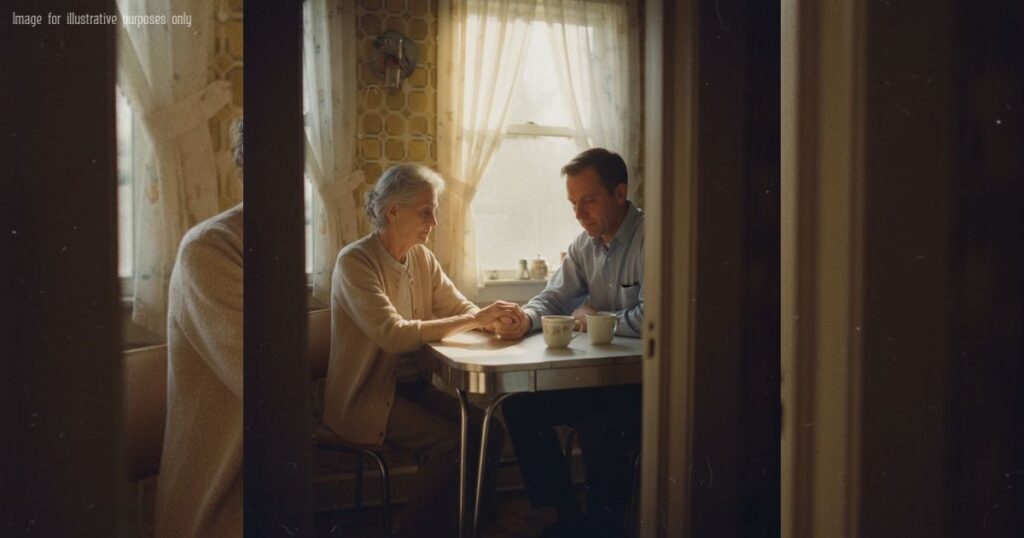
The morning after I called him my soulmate in that chair, he forgot how to turn the doorknob.
Not in a cute, absentminded way. Not in a “Where did I put my keys?” way.
In a way that made my blood turn cold.
I heard it from the kitchen—metal clicking, then a soft curse, then the strange silence of someone standing still because their brain is arguing with their hand. When I walked down the hall, he was in front of the bathroom door, staring at it like it had betrayed him.
His fingers kept twisting the knob, twisting and twisting, like repetition might wake the memory.
“Hey,” I said gently, the way you talk to a skittish animal. “You okay?”
He looked at me, embarrassed, cheeks flushing under the white stubble.
“This thing’s stuck,” he said.
It wasn’t stuck.
He wasn’t stuck.
Something else was.
I reached past him and turned it once. The latch clicked. The door swung open like nothing had happened.
For a second he laughed—this small, defensive laugh that tried to make it a joke. Then his eyes went glossy, like his body knew the truth before his pride was ready.
“I must still be half asleep,” he muttered, and slipped into the bathroom with the careful dignity of a man trying not to let his wife see him fall.
I stood in the hallway with my hand on the doorframe, listening to the sink run, listening to him breathe.
We are told to fear the big betrayals—cheating, lies, betrayal with lipstick stains.
Nobody warns you that time will cheat on you too.
And time doesn’t even have the decency to look guilty.
By noon, it got worse.
He was at the kitchen table, holding the same piece of mail like it was written in a foreign language. He turned it upside down. Then right-side up. Then he squinted so hard his face wrinkled into a tight knot.
“What is it?” I asked.
He swallowed. “It’s… it’s just words. They’re just… not landing.”
That sentence cracked something in me.
Because it wasn’t just words. It was him. The man who balanced checkbooks with a pencil behind his ear, the man who could calculate a tip in his head, the man who taught our daughter how to fill out her first job application—now staring at a simple letter like it was a test he was failing.
I wanted to wrap my arms around him and protect him from the world.
But the world was inside his skull now.
He blinked, and suddenly his face changed—like a light flickered.
“Sarah,” he said quietly, “I don’t feel right.”
And then his hand slipped off the table.
Not dramatic. Not a movie collapse.
Just… dropped. Like it belonged to someone else.
I was already moving before my brain caught up. My body remembered every crisis we’d ever had—every bill, every funeral, every midnight panic—and it snapped into survival.
I grabbed my phone. I grabbed my keys. I grabbed his coat even though it wasn’t cold.
He tried to stand, proud as ever. “I’m fine.”
But his legs wobbled like a newborn deer.
And I had the sudden sick thought: This is the moment where the man in the chair becomes the man in a hospital bed.
We spent the next hours under bright lights and buzzing machines, surrounded by strangers who spoke in calm voices that didn’t match the terror in my chest.
Someone asked me his birthday. Someone asked me what medications he took. Someone asked me if he’d hit his head recently.
I realized, standing there, that marriage turns you into a walking file cabinet.
You don’t just love someone.
You memorize them.
Their allergies. Their scars. Their history. The way their body fails when it’s trying to be brave.
He lay on a narrow bed, eyes fixed on the ceiling, jaw clenched like he was trying not to cry.
He looked at me and whispered, “Don’t let me be… like your mother.”
My mother had faded slowly, piece by piece, until she became a body that still breathed but no longer recognized the room she died in.
I squeezed his hand. “You’re not her,” I lied with my whole heart.
Because sometimes love is not telling the truth.
Sometimes love is holding someone steady while the truth shakes the floor.
They used words like “episode” and “event,” as if putting it in a neat label could make it less frightening. They talked about tests. They talked about follow-ups. They talked about “monitoring.”
Nobody said the sentence I was hearing anyway:
Your life is about to change.
When we finally got home that night, he moved through the house like a guest. He paused in the hallway, confused for a second, then forced a smile like he was okay.
I made him soup he barely touched. I set a glass of water by his chair. I watched him stare at the TV without really watching.
At some point, he reached for the remote and fumbled it, pressing buttons too hard, like it was slippery. He sighed, frustrated.
I took it from his hand gently and clicked the channel.
He looked at me, and in his eyes I saw a terrifying blend of gratitude and humiliation.
And that’s when I understood the first brutal truth of aging:
It doesn’t just take your body. It takes your pride.
The next day our daughter called.
She lives in another state now, like most kids do. A different zip code, a different life, the kind of distance that feels normal until something breaks and you realize love is not measured in miles—it’s measured in who can show up before the ambulance does.
“How bad is it?” she asked, voice tight.
“I don’t know yet,” I said. “But he’s… different.”
There was a pause. Then she said it. Carefully, like she was stepping around a landmine.
“Mom… have you thought about… options?”
Options.
That modern word we love because it makes everything sound simple and empowered, like picking a paint color.
Options, like a human life can be moved into a different container without spilling grief everywhere.
I knew what she meant.
A facility.
Assisted living.
A place with clean hallways and scheduled meals and people trained to deal with what wives aren’t trained to deal with.
And here’s where the story gets messy—where people start arguing in the comments before the sentence is even finished.
Because half the world will say, “You deserve a life too.”
And the other half will say, “You made vows.”
And both sides will talk like it’s a math problem.
As if love is just a formula: your needs + their decline = the correct choice.
But I’ll tell you what nobody wants to admit:
There is no choice that doesn’t hurt.
Keeping him home hurts.
Sending him somewhere else hurts.
Staying hurts.
Leaving hurts.
The only thing that changes is who carries the pain.
That week, I started doing something I never thought I’d do at this age.
I started hiding the car keys.
Not because he asked me to.
Because I saw him standing by the door one morning with his hand on the knob, staring out like the world was calling him back to the man he used to be.
“I’m just going to run out for a minute,” he said.
“To where?” I asked, pretending I didn’t already know.
He frowned, confused. “To… to the place. The—”
He couldn’t find the word.
Hardware store. Grocery. The familiar corner of his routine.
“The place,” he repeated, angry now.
I felt my throat tighten. “Honey, your doctor said—”
“Don’t start talking to me like I’m a child,” he snapped, and the sharpness of it cut deeper than a scream because it wasn’t him.
It was fear wearing his mouth.
I kept my voice soft. “I’m not. I’m talking to you like I’m scared.”
He stared at me. His eyes watered instantly, like the anger had been a thin mask over something raw.
“I don’t want to be useless,” he whispered.
And there it was—the real controversy nobody wants to talk about because it ruins the pretty “age gracefully” slogans.
Not the wrinkles.
Not the gray.
The humiliation of needing help.
The slow, daily theft of dignity.
By the weekend, our son came by.
He’s the practical one. The numbers guy. The one who thinks emotions are a leak you fix with a wrench.
He walked through the house, scanning it the way people scan a property listing.
“How much is the mortgage?” he asked.
“It’s paid off,” I said.
He nodded, then: “If it gets worse… you could sell. Downsize. Use the money for care.”
Care.
Another clean word.
Like what I was doing wasn’t care.
Like washing a man’s trembling hands at the sink wasn’t care.
Like keeping my voice steady when I was falling apart wasn’t care.
I looked at him and realized something else that made me want to laugh and sob at the same time:
People respect sacrifice as long as they don’t have to watch it up close.
They love the idea of devotion.
They hate the inconvenience of it.
He saw my face and softened a little. “Mom, I’m not trying to be cold. I’m trying to be realistic.”
Realistic is what people say when they want to move your pain into a spreadsheet.
I wanted to scream. Instead I said, “He’s still here.”
My son looked over at his father, who was in the recliner, staring at the TV without seeing it.
“Yeah,” he said quietly. “For now.”
That night, when everyone was gone, I sat on the edge of the bed and cried into my hands like a teenager.
My husband came into the room and stood in the doorway.
He watched me for a long moment. Then he said, voice small, “Did I do something wrong?”
I wiped my face fast. “No, honey. No.”
He took a few steps closer, like he wasn’t sure if he was allowed.
“I hate this,” he whispered.
“I know.”
He sat beside me and put his head on my shoulder like he used to do when he was young and invincible. His body felt heavier now. Older. But the shape of him was still mine.
“Promise me something,” he said.
“Anything.”
“If I turn into… someone you don’t recognize,” he said, words shaking, “don’t ruin your life trying to save mine.”
There are lines you hear that rearrange your whole soul.
That was one of them.
Because here’s the truth nobody wants to say in polite society:
Sometimes the person you love will ask you to abandon them out of love.
And sometimes the most moral thing you can do is not a clear yes or no.
Sometimes the moral thing is to sit in the gray.
“I can’t promise that,” I whispered.
He swallowed. “Why?”
Because I was thinking of that wedding photo. The lace. The hairspray. The naive hope.
And I realized what vows really are.
Not romantic.
Not poetic.
Vows are a contract with the future version of your life—the one you can’t imagine yet.
“I can’t promise that,” I said again, “because you didn’t abandon me when I was unbearable. You didn’t abandon me when grief made me cruel. You didn’t abandon me when money made us strangers.”
He stared at his hands. “That was different.”
“No,” I said, and my voice surprised me with how steady it was. “That was marriage.”
Here’s where the comments always explode.
Because in America right now, we’re living in a culture that worships two things at the same time—and they contradict each other:
We worship “self-care.”
And we worship “loyalty.”
We tell people, “Protect your peace.”
Then we post videos of someone caring for an elderly spouse and call them a hero.
We tell women, “Don’t settle.”
Then we shame them if they leave when life gets hard.
We tell men, “Be vulnerable.”
Then we ridicule them when they can’t provide like they used to.
We want love to be effortless.
But we only respect it when it bleeds.
And the algorithm—whatever faceless thing decides what we see—feeds that contradiction until we start believing we have to pick a side.
Saint or selfish.
Stay or go.
Devoted or “choosing yourself.”
As if humans can be reduced to hashtags.
I did something I’m not proud of.
I went online late one night and typed my story into a blank box on a discussion forum. No names. No brands. No details. Just the truth:
“My husband is fading. My kids want me to think about ‘options.’ He asked me not to ruin my life saving his. What would you do?”
Click the button below to read the next part of the story.⏬⏬