PART 2 — The Post That Started a Fire (and Why Dad Hated It)
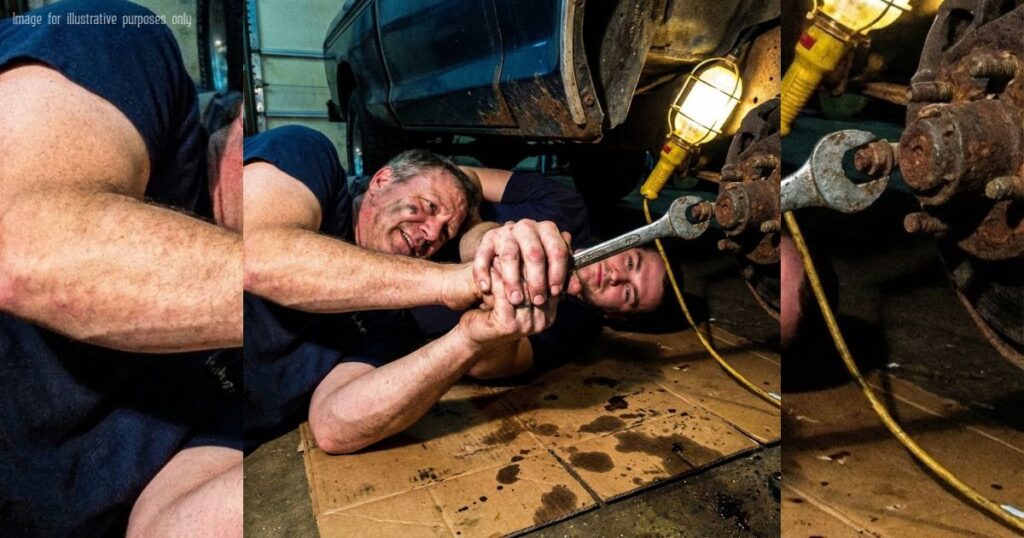
The bolt didn’t just surrender in that cold Ohio garage.
Something in me did, too.
Back in San Francisco, I walked into my glass office building with hands that still smelled faintly of gasoline and victory. I’d scrubbed them raw in airport bathrooms, but the grease had lodged under my nails like a secret. It was the kind of stain you don’t wash off—you either learn to live with it, or you learn to hide it.
I wasn’t sure which one I was.
At my desk, I slid the bone-handled pocket knife into the top drawer like it was contraband. The drawer was full of charging cords, stress balls, and a fancy notebook I’d never written in. The knife looked out of place there, like a coal miner sitting in a yoga studio.
My coworker Maya rolled past with a rolling chair and squinted at my knuckles.
“Did you… get into a bar fight?” she asked, half-laughing.
“Worse,” I said. “A starter motor.”
She stared at my hands a second longer than polite, like she was trying to decide if I’d suddenly become someone else. Then she shrugged and turned back to her dual monitors, where a dozen colored charts pulsed like heartbeats.
By 10:30, I was in a meeting called Q3 Emotion Strategy.
That was the actual calendar title.
Our creative director—fresh haircut, clean sneakers, perfect teeth—clicked through slides about “authenticity,” “belonging,” and “real-life moments.” There were stock photos of families laughing in kitchens that looked too expensive to be real. There were buzzwords about “community-first storytelling” and “human truth.”
Then he said, “People are starving for something tangible. Something real.”
He paused like he’d just invented reality.
“We need more grit,” he added. “More… blue-collar energy. Less polished. More lived-in.”
I felt my pockets for a second, like the knife might be burning through my slacks.
My manager leaned toward me, lowering her voice. “Your story from home,” she whispered. “The truck. Your dad. That’s… content.”
Content.
That word landed on my ribs like a cheap punch.
I nodded because that’s what I’m trained to do. I nodded because in my world, everything that moves is a potential campaign. I nodded because I didn’t want to be the guy who flies to Ohio, bleeds on a wrench, and comes back acting like he’s above the machine that pays his rent.
But inside, something got tight.
That night, I couldn’t sleep.
I kept hearing the engine roar in my head, kept feeling my father’s hand over mine on that ratchet handle. I kept thinking about his voice, thin as paper, when he said he was useless. I kept imagining him sitting alone in that house, with a TV that felt like a spaceship and a world that kept demanding passwords.
So at 1:12 AM, with the city outside my window blinking and humming, I did what my generation does when we feel too much.
I posted.
Not a polished video, not a professional photo. Just a close-up of my hands on my desk—scraped knuckles, grease in the creases, the bone-handled knife beside my keyboard like a relic. I didn’t name my company. I didn’t name my dad. I wrote it like a confession:
My father asked for help with a stuck bolt. It wasn’t about the bolt. It was about him feeling erased. If your parents call you with something “small,” don’t send money. Show up. Be the muscle. Let them be the map.
I hit publish and immediately felt sick.
Not because it wasn’t true.
Because I knew what the internet does to true things.
By sunrise, my phone was vibrating itself off the nightstand.
Hundreds of notifications. Then thousands. People were sharing it with captions like “CALL YOUR DAD” and “THIS BROKE ME.” Strangers were tagging siblings. People were writing long paragraphs about fathers, mothers, uncles, grandparents. Mechanics and nurses and teachers and electricians and office workers were all piling into the same comment section like it was a town hall that didn’t require leaving your couch.
And then the argument started.
It always does.
One camp clung to the post like a life raft.
“THIS IS WHAT FAMILY IS.”
“STOP MAKING EXCUSES AND GO HOME.”
“OUR PARENTS DID EVERYTHING FOR US.”
The other camp came in with their own bruises.
“Not all parents are safe.”
“Some of us had to choose peace.”
“Stop guilt-tripping strangers with trauma.”
Then there were the people who made it about “generations,” like everyone alive fits neatly into labeled bins.
“Kids are weak now.”
“Old people refuse to adapt.”
“Boomers ruined everything.”
“Everyone’s addicted to screens.”
It was messy, loud, and weirdly intimate, like watching strangers cry in public and then start debating whose tears are allowed.
My post wasn’t even 150 words. Yet somehow it turned into a battlefield about obligation, boundaries, pride, masculinity, and whether love comes with an invoice.
And the worst part?
A lot of it made sense.
In the break room at work, Maya looked at me over her coffee.
“Was that you?” she asked quietly.
I nodded, embarrassed.
She didn’t congratulate me. She didn’t call it inspiring. She just said, “I get it.”
Then she added, “But also… my dad’s the reason I know what a locked bathroom door sounds like. So when people tell me to ‘just show up’—it’s not that simple.”
Her voice wasn’t angry. It was flat, like she’d practiced saying it without shaking.
I swallowed. “Yeah,” I said. “You’re right.”
And suddenly, my chest felt split down the middle.
Because I could hold my father’s hand over a ratchet and still acknowledge that some hands hurt you. I could believe in showing up without turning it into a commandment. I could love my dad and still admit the truth: his rules—never cry, never interrupt a man earning a wage—weren’t harmless for everyone.
They shaped me.
They sharpened me.
They also cut me.
By noon, my manager was at my desk with her laptop open and her eyes bright in that corporate way that says I smell opportunity.
“This is incredible engagement,” she said. “Like… unreal. People are responding to your authenticity. We could build a whole series around it. ‘Hands That Built America.’ Short-form videos. User stories. A landing page. We’ll highlight trades. Family. Connection.”
Click the button below to read the next part of the story.⏬⏬