She said it like she was proposing a charity, not a funnel.
I stared at the little scabs on my knuckles and tried to imagine my father as a bullet point. I tried to picture him being turned into a “relatable moment” with background music and captions.
My stomach turned.
“I don’t think he’d like that,” I said.
My manager blinked. “It’s not about him specifically. It’s about the insight. We’re not exploiting. We’re amplifying.”
Amplifying.
Another word that can mean “make louder” or “strip for parts.”
I heard my father’s voice again—Keep it sharp.
I opened my desk drawer and touched the knife without pulling it out.
That afternoon, I called him.
He answered on the second ring, like he’d been sitting beside the phone waiting to prove he wasn’t lonely.
“Leo,” he said, gruff. “You okay?”
“I’m fine,” I said. “How’re you?”
A pause. Then, “Why’s the neighbor’s kid texting me like I’m some kind of… internet hero?”
My throat tightened. “She saw a post.”
“You posted about me,” he said. Not a question.
“I didn’t say your name,” I rushed. “I didn’t—Dad, it was about the message. About—”
“You made me a story,” he cut in, and there was something raw under his irritation. “I’m not a story.”
“I know,” I said, quieter. “I’m sorry.”
He exhaled hard, the kind of breath a man takes when he’s holding back the thing he was trained not to say.
“People in town are looking at me different,” he muttered. “Like I’m… fragile.”
“You’re not fragile,” I said.
“That’s not the point,” he snapped. Then his voice dropped. “You don’t understand what it costs a man to be seen that way.”
I did understand.
I just hated that he was right.
“Dad,” I said, “I didn’t post it to embarrass you. I posted it because I was proud of you. You didn’t quit. You let me in.”
Silence on the line.
Then, softer: “I didn’t ‘let you in.’ We needed two hands.”
“Exactly,” I said. “That’s the whole thing.”
He didn’t respond for a long moment. When he finally did, his voice sounded tired.
“Next time you feel something, Leo,” he said, “you call me. You don’t call the whole world.”
I closed my eyes. “Deal.”
He cleared his throat. “Also… that thermostat thing you mentioned. The heat keeps turning itself down at night. I wake up freezing. I think it’s haunted.”
I laughed—an actual laugh—because it sounded like him again.
“It’s not haunted,” I said. “It’s probably on a schedule.”
“A schedule,” he grumbled. “Everything’s got a schedule now. Even the heat thinks it knows better than me.”
And there it was—the real fight.
Not me versus him.
Not old versus new.
It was a man who spent his life mastering machines that obeyed, now living in a world of machines that decide.
That night, I lay in bed staring at the ceiling while my phone kept lighting up with arguments under my post. People fighting about what adult children owe. People fighting about whether older generations earned respect or demanded it. People fighting about whether pride is strength or poison.
I wanted to jump into the comments and fix it, like a bolt. Apply the right pressure. Find the rust. Make it surrender.
But human beings aren’t bolts.
You can’t just muscle your way into reconciliation.
And you definitely can’t monetize it without losing something.
In the morning, I went into the office early. The building was quiet, the city still gray with fog. I opened my desk drawer and held the pocket knife for a second.
It wasn’t a weapon.
It was a reminder: some things are meant for your hand, not an audience.
When my manager came in later and asked again about “turning it into a campaign,” I didn’t raise my voice. I didn’t make a speech. I just said, “No.”
She blinked like I’d spoken a foreign language.
“No?” she repeated.
“No,” I said, steady. “That story isn’t for sale.”
Her smile tightened. “You know this could be big for your career.”
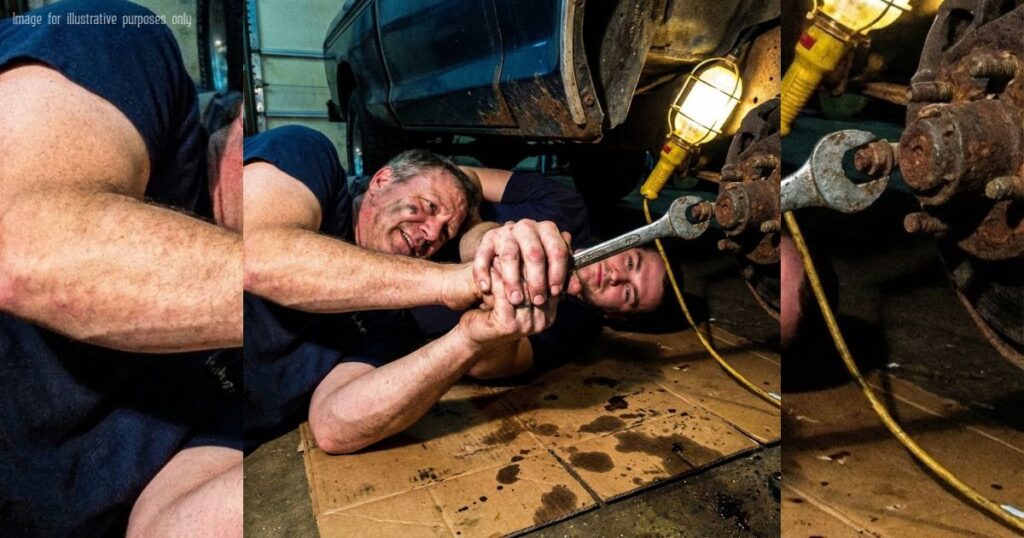
I thought of my father on that overturned bucket, staring at his swollen knuckles like they’d betrayed him. I thought of how small he looked until the engine started. I thought of how he sounded when he said, I’m not a story.
I looked at my manager and said, “So could being human.”
She walked away, annoyed.
My hands didn’t shake.
Later that day, my phone rang again at 10:14 AM.
Same time as before.
My father’s name on the screen.
My heart did the same drop.
I answered fast. “Dad?”
His voice came through quieter than usual. Not paper-thin this time. Something else.
“Leo,” he said. “You remember where I keep the title for the truck?”
I sat up straighter. “Yeah. Why?”
Another pause. A breath.
“Because I got an offer,” he said, and I could hear him trying to sound casual, trying to make it small. “A guy saw it running. Says he’ll pay cash. Says it’s time I get something newer. Something… smarter.”
My throat went dry.
“And?” I asked carefully.
“And I told him,” my father said, voice low, “that if a machine needs to be smarter than me to work, maybe it’s not for me.”
I let out a breath I didn’t know I was holding.
But then he added, softer, almost like he was confessing a crime:
“Still… I didn’t sleep much last night, Leo. My hands hurt. And I kept thinking about what you wrote. About being… unnecessary.”
The words sat between us, heavy.
I swallowed.
“Dad,” I said, “you’re not unnecessary.”
He didn’t argue.
He just said, “Then prove it.”
And in that moment, I understood the real controversy my post had lit up.
It wasn’t about whether you “owe” your parents.
It wasn’t even about generational war.
It was about this: in a world that turns everything into content, convenience, and upgrades, who do we leave behind when they can’t be optimized anymore?
My father didn’t want to be viral.
He wanted to be needed.
I stared at the fog outside my window, at the city that runs on apps and schedules and silent loneliness, and I gripped the phone tighter.
“Okay,” I said. “Tell me what’s going on.”
He exhaled, and for the first time, he didn’t sound angry.
He sounded scared.
“Leo,” he whispered, “I think I’m losing my grip again… and this time it isn’t a bolt.”
Thank you so much for reading this story!
I’d really love to hear your comments and thoughts about this story — your feedback is truly valuable and helps us a lot.
Please leave a comment and share this Facebook post to support the author. Every reaction and review makes a big difference!
This story is a work of fiction created for entertainment and inspirational purposes. While it may draw on real-world themes, all characters, names, and events are imagined. Any resemblance to actual people or situations is purely coincidenta